Let’s Talk About: Cranberry Glass

Do you recall your mother or grandmother having any cranberry glass? This very special type of glass became famous in the Victorian Era in Britain and came with the English immigrants to America. Cranberry glass creations were most popular as a table display, often holding candy or flowers. 

If you happen to have one of your grandmother’s cranberry glass pieces, please know that it is highly collectible but its value varies wildly from $10 to thousands of dollars! The value of the piece is determined by the amount of gold used to make the rich color.

Antique cranberry glass is occasionally found in old outhouse pits (privies). Before city trash pickup, people threw broken household trash—including expensive glassware—into outhouse holes. 

I became intrigued when viewing a YouTube video where a fellow found cranberry glass in an old privy pit! (No comments on my eclectic viewing habits, please. 🙂 Videos

Cranberry Glass and a Small Figure – Bottle Dump FindsYouTube · Mudlarking with SteveDec 15, 2025YouTube · Mudlarking with Steve

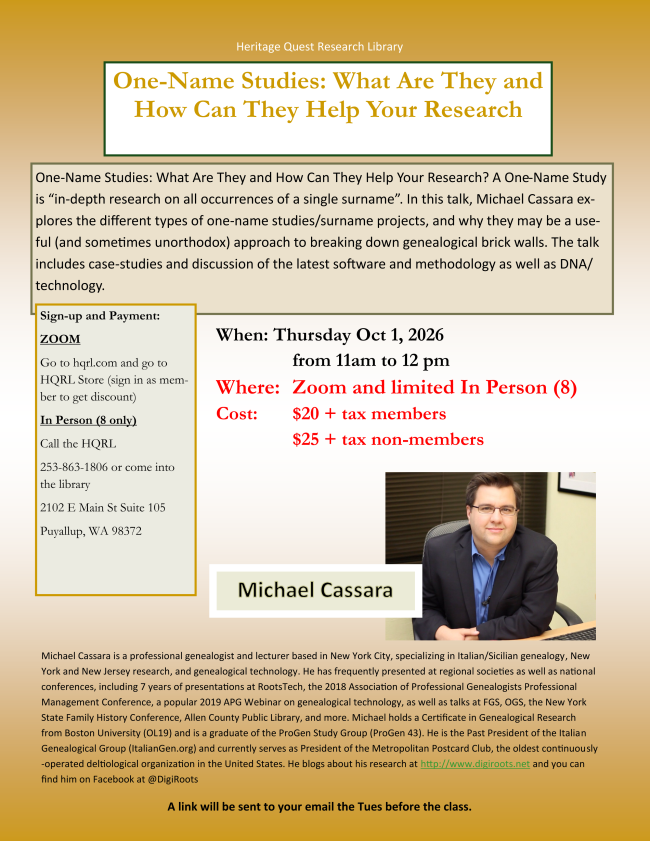
Italian Interest Group Update on FamilySearch and Italian Records

Italian Interest Group (IIG) SEPTEMBER 2026 MEETING
Click to Request the Zoom meeting invitation
DATE:September 19, 2026
TIME:1:30 PM (PT)
TOPIC:Update on FamilySearch and Italian Records
PRESENTER:
Joel Cole
Description:   In this presentation “Update on FamilySearch and Italian Records,” the following topics will be discussed: An overview of the principal repositories of Italian genealogical and historical records throughout Italy.The latest updates and developments on the FamilySearch website.Recent developments in FamilySearch’s collaboration with the Direzione Generale Archivi (DGA) and other Italian institutions.Future expectations regarding Italian records, including upcoming acquisition initiatives and the availability of new indexes and searchable collections.
Presenter: Joel Cole was born and raised in Padova, Italy. He has been involved with Italian Family History for over 30 years. He accompanied his father Trafford for his first genealogical research in Maniago, Italy, when he was 15 and since then he has been fascinated by family history. He has worked as a researcher for over 25 years, visiting almost every State Archive in Italy and almost 1,000 parish archives. He is familiar with paleography having taken several classes in Italy, and with Latin documents, having studied it for over 10 years. Joel has presented in many international genealogical conferences about Italian Family History and has worked for years for private companies performing research in all of Italy, consulting Civil records, Parish and Diocesan Catholic records, Notary records and many more sources. In 2015 he moved to Utah covering several roles for FamilySearch. He is currently the content strategist for Southern Europe, including Italy. Joel’s research specialties are: Italy, Southern Switzerland and Istria-Croatia. Expert at deciphering ancient Italian and Latin documents.
COUNTDOWN TO THE MEETING:
Days Hours Minutes Seconds
Italian Interest Group (IIG) of theEastside Genealogical Society P.O. Box 374
Bellevue, WA 98009-0374

Tacoma Pierce County Genealogical Society DNA SIG Meeting

Tacoma-Pierce County Genealogical Society DNA Special Interest Group Meeting
Tuesday, July 28, 2026, Starting at 7:00 pm via Zoom

Discussion group focused on various topics regarding the use of DNA testing in genealogy.

Prior to this meeting we will watch the webinar Cousins, Clusters, and Clues: Using MyHeritage DNA for Your Genealogical Mysteries available for free on Legacy Family Tree Webinars at:
https://familytreewebinars.com/webinar/cousins-clusters-and-clues-using-myheritage-dna-for-your-genealogical-mysteries


Calendar reminder: TPCGS DNA Special Interest Group Meeting

Every month on the Fourth Tuesday beginning at 7:00 PM Pacific Time

Please download and import the following iCalendar (.ics) files to your calendar system.

Monthly: https://us02web.zoom.us/meeting/tZYqdeyrrz0iEtx-c_J3gNfcI8mebT1zajLo/ics?icsToken=98tyKuGqqTkvGdWTuBGPRpwQB4joZ-nzmCFHj7dF0RzaKXNUTAX1H7pPN7BLQcLR

Join Zoom Meeting:
https://us02web.zoom.us/j/82725316888?pwd=MDc3UEZrUVJNbmxmK2ZORmw5YzdDdz09

Meeting ID: 827 2531 6888
Passcode: 811780

One tap mobile:
+12532050468,,82725316888#,,,,*811780# US
+12532158782,,82725316888#,,,,*811780# US (Tacoma)

Dial by your location:
        +1 253 205 0468 US
        +1 253 215 8782 US (Tacoma)
Meeting ID: 827 2531 6888
Passcode: 811780

Find your local number: https://us02web.zoom.us/u/kIKCyZLQy
America at 250 Phineas Camp

The Remarkable Life of Phineas Camp

by Janice Moerschel

Phineas Camp, my four-times great-grandfather, lived nearly a century and witnessed early America’s defining events.Born 13 Jan 1744 in Durham, Connecticut, he served in two wars, resettled in central New York, and raised a large family.

Before the Revolution, Phineas served in the French and Indian War, including Connecticut service for the relief of Fort William and Henry in 1757 and a later call-up in 1759.

War reached him again with the American Revolution. Phineas took the oath of fidelity in 1777 and enlisted with the Connecticut Continental Regiment, with records placing him in service through Dec 1779. One later record says that by 1 Jan 1780 he was either “discharged or had deserted.” His oath, documented service, later civic roles, and respectful obituary point more toward discharge, though the record is not conclusive.

Phineas married Martha T. Hall on 8 Jan 1767 in Connecticut, and their first son was born later that year. The family appears in Connecticut in the 1790 U.S. census, then moved about 1793 to Whitesboro, Oneida County, New York. There Phineas bought land, farmed, and held offices including surveyor of highways, constable, grand juror, and inspector of provisions. Federal censuses from 1800 through 1840 place the family in Whitesboro as the Erie Canal was built and opened nearby.

Phineas died on 13 Jul 1843. Portions of his obituary, published in the Albany Evening Journal on 17 Jul 1843 after first appearing in the Utica Gazette, are excerpted below.

Death of a Revolutionary Soldier

… Mr. Phineas Camp, who died at the home of his son in the village of Whitesboro, on Thursday at 3 o’clock P.M., aged 99 1/2 years.

Mr. Camp came into this county 50 years ago; purchased his farm and continued to cultivate or superintend it until about ten years since. He walked about, smoked his pipe, and read his Bible as usual until within twelve hours before his death. The immediate cause was the prevailing influenza.

He was a man of plain, strong sense, firm determination, and of deep, though not lively, affections.

His long life was owing, as nearly as could be learned, to inherited vigor, temperance in eating and drinking, and almost entire abstinence from medicine.”

He went to sleep full of years, respected and beloved, surrounded by his children, to whose tender and unremitting attentions he was indebted for many benefits during the last of his life.” — Utica Gazette.

The number of children Phineas and Martha raised is unclear. FamilySearch.org lists 12 offspring, but I have seen numbers ranging from 11 to 17, likely reflecting incomplete records, repeated names, or uncertain links.

Phineas is buried at Grandview Cemetery in Whitestown, Oneida County, New York and is recognized by the Daughters of the American Revolution as a verified patriot ancestor #A214794, leaving a legacy that joins documented public service with the quieter endurance of a large and far-reaching family line.

Headstone photo from FindAGrave.

Colorado Chapter Palatines to America

The Colorado Chapter of Palatines to America has several upcoming events this fall, and we would be grateful if you could share them with your members, post them on your websites, or include them in your newsletters.

Monthly Focus Group Tuesday, August 11 at 6:30 PM MDT Zoom only Featuring Karen Ellingson Topic: Free and Frugal Genealogy Resources To receive the Zoom link, please email Jennifer Bigham at dbigham72@gmail.com.

Fall Seminar Saturday, October 3 In-person and Zoom Registration coming soon Featuring Gail Blankenau Topics include: • Power Combination: German Church Records and Farm Histories • Finding Your Family in Numbers: How to Find and Navigate German Census Records • Finding Your Germanic Home Village and Parish • Mountain Peaks and Trails: Your Swiss Ancestral Journey

Let’s Talk About: Odd Fellows Halls

This sad looking building in northeast Spokane (Hillyard, actually) was an important social hub back in the day. It was built to serve the booming railroad community that sprang up after James J. Hill decided to avoid Spokane taxes and build his railroad shops in that area..which ultimately was named after him. 

In the 1880s, Spokane was becoming the premier rail hub of the west and tycoon James J. Hill wanted it on his Great Northern line to the coast. Hill had the “hutzpah” and pulled the right strings to achieve his goal. The Hillyard yard became the biggest rail shop west of the Mississippi. 

To help the families and the workers, several fraternal organizations sprang up in the area. The Odd Fellows Hall was one. Located on North Market Street, the hall hosted community dances, meetings and charitable gatherings but the purpose of the organization was to “visit the sick, relieve the distressed, bury the dead and educate the orphan.” Since one goal of the group was to provide burial for its members, they established Resthaven Cemetery (now Evergreen Cemetery). The building was completed in 1896.

According to an article in The Spokesman Review, March 7, 1996, “Built by lodge members from Waverly, it opened on March 17, 1896, according to John Nunn, a member who keeps many of the lodge’s historical documents.” The article spotlighted that the Lodge’s centennial celebration was being held on March 10, 1996, with members planning a picnic “and the lodge will lay out its old photographs and letters, dues ledgers, attendance books and documents, including the original deed that passed the property to the lodge.”The question screaming into my mind is where are those documents today????? My husband’s grandfather worked for the railroad in Hillyard in the 1920s….. might he have been a member of this lodge? Wouldn’t we like to access these records of our ancestors? 

P.S. In 1900, there were about 170 Odd Fellows Lodges in Washington; some 25 are still active today. 

WAS YOUR ANCESTOR A MEMBER OF AN ODD FELLOWS LODGE???

Let’s Talk About: Who Was John Day?


Little is known about the man for whom a river, a dam and two towns (John Day and Dayville) were named.  The following story is based on historical fact – some of it may be true. Pictured is an illustration of what John Day might have looked liked.

“John Day,1770-1820,  was a hunter from the backwoods of Virginia.  He had been employed by Ramsay Crooks for several years when he arrived in Oregon, at about 40 years of age.  He was described as “six feet two inches tall, a handsome man with a manly countenance, straight as an Indian with an elastic step ‘as if he trod on springs'”.  It was his boast that in his younger days nothing could hurt or daunt him, but he had lived too fast and injured his constitution by excesses.  Still, he was strong of hand, bold of heart, a prime woodsman, and an almost unerring shot.”

Website FindAGrave has his biography of him (plus several more pages). He was most surely quite the guy. His death and burial place as noted on FindAGrave states “buried or lost at sea. Specifically: Drowned in Snake River.” 

John Day Dam, spanning the Columbia River kinda between The Dalles, Oregon, and Goldendale, Washington, was constructed between 1958 and 1971, costing $511 million dollars. It has a fish ladder and a navigation lock, that lock being 110-feet, the highest lock-lift on the river. The dam forms Lake Umatilla, a 76-mile long reservoir. 

Next time you zoom along I-80 in Oregon along the Columbia River, pause to appreciate the John Day dam and remember the hardy frontiersman who was John Day. 

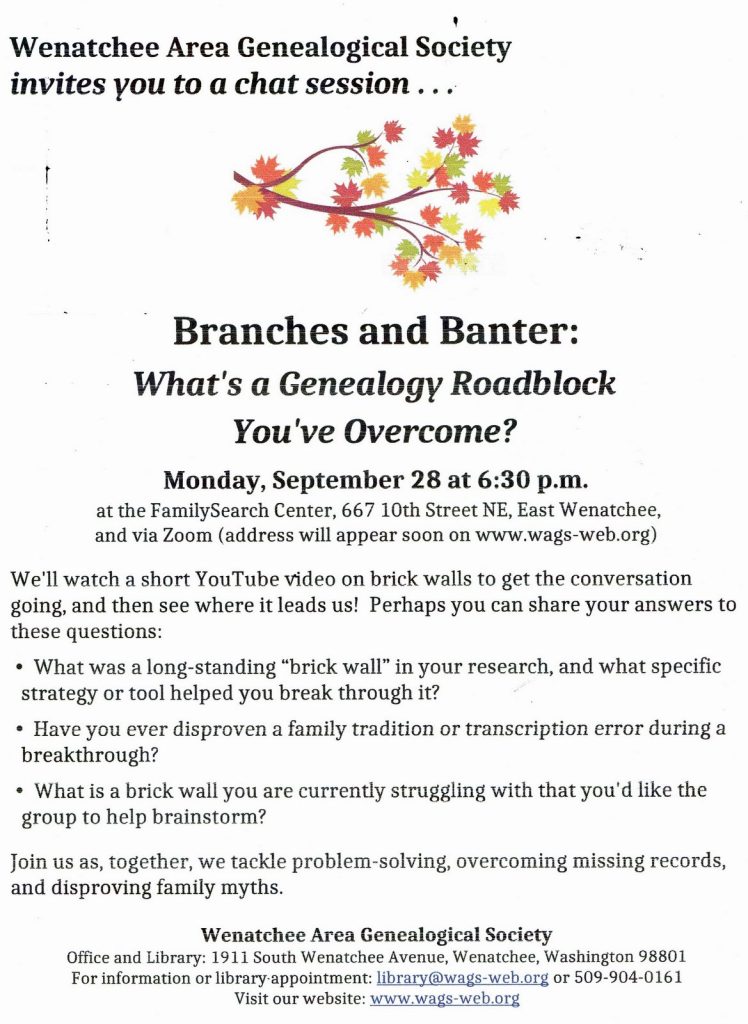
Tacoma Pierce County Genealogical Society Chat

Tacoma-Pierce County Genealogical Society Genealogy Chat
Tuesday, July 21, 2026, starting at 7:00 PM via Zoom

Please join us and let’s chat!

Discussion starter topic
“How many generations back is your most distant known ancestor, who are they, and how did you find them?”

This is a monthly opportunity to connect with others and talk about anything and everything about genealogy.
The value of this meeting increases with the participation of each person that attends and contributes to the conversations. This is your chance to celebrate the breaking down of a brick wall in your research or ask questions of others that can help you find records or relatives. Everyone, members, and guests are welcome and encouraged to attend and participate.

Date & Time: Every month on the Third Tue, from 7:00 PM until 8:30 PM Pacific Time

Please download and import the following iCalendar (.ics) files to your calendar system.

Monthly: https://us02web.zoom.us/meeting/tZMldOCprTsqGtSoVglOBTElUaBRgTq5IEgI/ics?icsToken=98tyKuGvpjgjG9eVsBmHRpwEGojCXevztmJfjbdukyniDw9xVib6A-NgALVLAY35

Join Zoom Meeting:
https://us02web.zoom.us/j/87839130000?pwd=dGdHY2wrZ0d1bDNRTEQ4Uk15OVk0Zz09
Meeting ID: 878 3913 0000
Passcode: 836216

One tap mobile:
+12532050468,,87839130000#,,,,*836216# US
+12532158782,,87839130000#,,,,*836216# US (Tacoma)

Dial by your location:
        +1 253 205 0468 US
        +1 253 215 8782 US (Tacoma)
Meeting ID: 878 3913 0000
Passcode: 836216

Find your local number: https://us02web.zoom.us/u/kdesX0el3t

America at 250 Elisha Story

Dr. Elisha Story: A Revolutionary Cousin with a Boston Tea Party History

by Janice Moerschel

In researching my family history, I often come across names that at first appear only as basic genealogical facts: dates, places, marriages, and family connections. Dr. Elisha Story, my third cousin seven times removed, caught my attention. He is one of those relatives whose record leads well beyond the family tree and into the history of Revolutionary Boston.

Elisha was born in Boston, Massachusetts, on 3 Dec 1743, into the Story family line that traces back to my immigrant ancestor, William Story, who arrived in New England in the seventeenth century. Like my direct Revolutionary ancestor Ebenezer Story (The Story Behind a Story: Ebenezer Story of Revolutionary Connecticut) Elisha belonged to a family whose roots were already deep in colonial Massachusetts by the time resistance to British rule began to intensify.

Massachusetts was one of the centers of colonial frustration, and Elisha came of age in a world charged with the issues surrounding taxation, representation, and rights. He joined the Sons of Liberty, the patriot network that included historical figures like Samuel Adams, John Hancock, and Paul Revere. He was also known as a close friend of Dr. Joseph Warren, one of the most important patriot leaders in Boston before the Revolution.

On 16 Dec 1773, Elisha stepped into one of the defining acts of American resistance to the tax on tea. That night, men disguised themselves as Mohawk Indians and set off from Griffin’s Wharf into the Boston Harbor, where three ships carrying East India Company tea lay in waiting. Elisha was among the participants who boarded the vessels and threw the tea overboard. Some accounts describe him as a leader of the group, but historians do not all agree on the extent of his role. What is clear is that he was not merely sympathetic to the cause – he participated in it.

Elisha’s commitment continued during the Revolutionary War. As a physician and surgeon, he served during the Lexington and Concord alarm and fought briefly at Bunker Hill before tending to wounded soldiers. One especially tangible reminder of his service survives: his medical chest, reportedly used during the war and now preserved as part of Marblehead’s historical memory.

Dr. Story died 27 Aug 1805 at Marblehead, Massachusetts.

Medical chest of Elisha Story. Photo courtesy of the Museum of Marblehead (Mass.)

After the war, Elisha returned to Massachusetts, helped manage a serious smallpox outbreak around Marblehead, and settled there permanently. He had married Ruth Ruddick on 12 May 1767 in Boston, Massachusetts, with whom he had 11 children. After Ruth’s death, his second wife Mehitable Petrick raised those children. One of them was Joseph Story, who would become an influential Supreme Court Justice.